Showing posts with label transportation. Show all posts

Tuesday, July 19, 2011

Ongoing protest against the destruction of Plaza Americo Brum

This morning, residents of Rio's oldest comunidade, Morro de Providencia, gathered around Plaza Americo Brum to protest its destruction by the municipal government. Part of the "Morar Carioca" (Rio Resident Living) initiative, the plaza's destruction marks the beginning of the installation of the Providencia teleferico, which I blogged about last week.

As of now, residents have succeeded in delaying the Plaza's demolition. In doing, so, however, residents were subject to intimidation tactics and were denied access to Plaza - which is a public, open space -by the police who staff the community's very own UPP.

As the Pela Moradia (For the Right to Housing) blog explains,

Hoje, pela manhã, os moradores haviam programado um café da manhã, como uma forma de protestar contra o fim da praça Américo Brum... Entretanto, com a ajuda de policiais da UPP local, os responsáveis pela obras invadiram a praça e a cercaram, impedindo a entrada dos moradores.

This morning, the residents [of Providencia] had scheduled a breakfast [in the Plaza] as a means of protesting the demise of Plaza America Brum...However, with the help of police from the area's UPP, those responsible for the construction [of the teleferico] invaded the Plaza and surrounded it, impeding the entry of residents.

Like most mega-event-related construction, the project's blueprint has not been made available to the public, has incorporated no amount of community involvement, and will displace hundreds of families. The Plaza's unfortunate fate undermines laws which protect against destruction of property which serves "a social function", and circumnavigates legal instruments which forbid preemption, the destruction of "patrimonio" (property of cultural and historical significance) and the privatization of public space (here, it should be noted that Brazil's transit system is privately-held).

Furthermore, the destruction of the Plaza coincides with the height of winter vacation for Brazilian public school students, meaning that Providencia youth will have no leisure area in which to play and socialize. There has been no talk of when - or if - the Plaza will be reconstructed elsewhere.

If you want to see photos of the ongoing protest, Viva Rio's Viva Favela website has several.

Monday, July 11, 2011

"E so para gringo ver"

Today, President Dilma Roussef announced that the Complexo do Alemao, the sprawling conglomeration of 13 comunidade's in Rio's North Zone, "has everything it needs to become a tourist attraction."

Roussef's remarks come after her inaugural ride on the 6-station teleferico last week. The President expressed pride and hopefulness when asked about the recent Accelerated Growth Program (PAC) upgrading that has taken place in the Complexo since it was occupied by the military last fall, stating:

"O PAC está mudando a vida no Complexo do Alemão. Por isso, para mim foi motivo de orgulho fazer a viagem inaugural do teleférico, passando pelas seis estações do Complexo do Alemão. A subida do morro passou a ser feita com conforto, com segurança e em apenas 15 minutos - disse. - O Complexo do Alemão tem tudo para se transformar em um ponto turístico." "The Program for Accelerated Growth is changing lives in the Complexo do Alemao. So, for me, accompanying the teleferico's first voyage filled me with pride, passing through the six stations of the Complexo do Alema. The climb up the hill can now be done with comfort, security, and within 15 minutes. The Complexo do Alemao has all it needs to become a tourist destination."

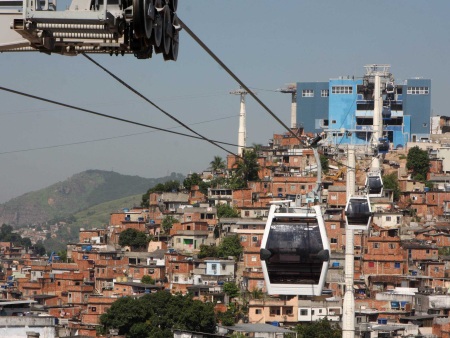
One of the 6 teleferico stations in Alemao. All are located on
summits of the hills that comprise the Complexo. Photo credit: R7
Dilma went on to claim that 85,000 people will directly benefit from the installation of the teleferico. Who these 85,000 people will be is anyone's guess. Certainly, they are not the 85,000 residents of the comunidade. And why not, you ask? Well: If you pay a visit to the Complexo to inspect the newly-installed teleferico, you will notice something odd. The six stations Dilma mentions are all located at the summits of hills on which they stand, meaning that a resident who lives toward the middle or bottom of the hill would need to walk all the way up to the top to access the transport system. Is the government truly suggesting that a Complexo resident will embrace the addition of a 20-minute hike (and possibly a BRL $3 expense) to his morning commute, when he could....walk down the hill...for free? Given that the Complexo's hills are already serviced with "moto-taxis" (motorcyle taxis) and "combis" (small privately-owned vans), commuting back up the hill at the end of the day via the teleferico also seems like an unlikely undertaking for a resident. Additionally, a resident of the hill constituting the teleferico's last stop would seemingly have to travel across the six other hills to get to his destination. Would he not opt for a moto-taxi, foot, or combi from the base of his respective hill? Does this commute revision really save him time? Or money?*

In light of the mega-event-related revitalization of Rio's Port Zone, the municipal government is pitching a similar argument in favor of an identical teleferico in the Morro de Providencia. The installation of the teleferico will force the eviction of up to 300 families, prompting further speculation about who the true beneficiaries of the transport system truly are.


Having spoken to residents of both communities, it seems clear that the telefericos will not be used largely among Providencia and Complexo families. Cost, inappropriate positioning of stations, and "e so para gringo ver (it's just for tourists to see) were all cited by residents as proof that the system has not been catered to their needs. Additionally, it is notable that community residents underscore the importance of educational and job opportunities, healthcare access, and proper sanitation over the installation of the teleferico.


E so para gringo ver, indeed.


*in an interview with leading political scientist Maria Helena Moreira Alves, I was informed that Providencia residents will have free access to the teleferico only for the initial two months after the inauguration.

Sunday, June 26, 2011

Analogy fail.

This weekend, O Globo quoted mayor Eduardo Paes as saying that the restorations in Rio's Port Zone are comparable to the Olympic-related upgrading in East London.* Seemingly, this comparison was based on the fact that both restorations are taking place in "degraded neighborhoods". Yes, folks, the similarities are almost overwhelming!

No, in fact, they are not. The similarities end right there. Let's take a look at a few things East London and the Port Zone revival projects definitely DO NOT have in common. Behold:

London has designated nearly half of its Olympic Village housing units for low-income occupation after the Games. Does that compare to the forced removals of comunidade residents in the Port Zone (see: Providencia)? Does that compare to not offering to re-house these families in anything remotely on-par with an Olympic Village apartment?

Is East London also installing some sort of tourist-oriented teleferico that no one who lives in East London will actually use? Will East London's teleferico also necessitate removing some of the city's poorest residents so that gringo tourists can enjoy a scenic view?


The jokes write themselves, my friends.

*Paes also failed to correctly name the region of London in question. In fact, he said "West Zone" of London.