Showing posts with label evictions. Show all posts

Tuesday, July 19, 2011

Ongoing protest against the destruction of Plaza Americo Brum

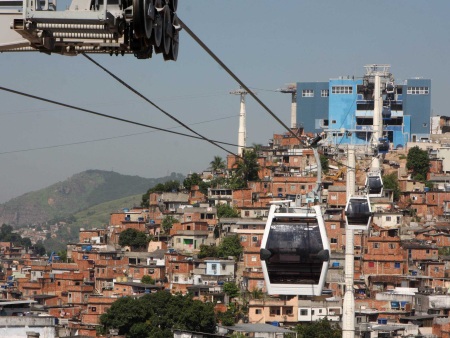
This morning, residents of Rio's oldest comunidade, Morro de Providencia, gathered around Plaza Americo Brum to protest its destruction by the municipal government. Part of the "Morar Carioca" (Rio Resident Living) initiative, the plaza's destruction marks the beginning of the installation of the Providencia teleferico, which I blogged about last week.

As of now, residents have succeeded in delaying the Plaza's demolition. In doing, so, however, residents were subject to intimidation tactics and were denied access to Plaza - which is a public, open space -by the police who staff the community's very own UPP.

As the Pela Moradia (For the Right to Housing) blog explains,

Hoje, pela manhã, os moradores haviam programado um café da manhã, como uma forma de protestar contra o fim da praça Américo Brum... Entretanto, com a ajuda de policiais da UPP local, os responsáveis pela obras invadiram a praça e a cercaram, impedindo a entrada dos moradores.

This morning, the residents [of Providencia] had scheduled a breakfast [in the Plaza] as a means of protesting the demise of Plaza America Brum...However, with the help of police from the area's UPP, those responsible for the construction [of the teleferico] invaded the Plaza and surrounded it, impeding the entry of residents.

Like most mega-event-related construction, the project's blueprint has not been made available to the public, has incorporated no amount of community involvement, and will displace hundreds of families. The Plaza's unfortunate fate undermines laws which protect against destruction of property which serves "a social function", and circumnavigates legal instruments which forbid preemption, the destruction of "patrimonio" (property of cultural and historical significance) and the privatization of public space (here, it should be noted that Brazil's transit system is privately-held).

Furthermore, the destruction of the Plaza coincides with the height of winter vacation for Brazilian public school students, meaning that Providencia youth will have no leisure area in which to play and socialize. There has been no talk of when - or if - the Plaza will be reconstructed elsewhere.

If you want to see photos of the ongoing protest, Viva Rio's Viva Favela website has several.

Sunday, July 17, 2011

On gringos, comunidades, and NGOs

Francisca and her family moved to Rio from the Northeastern
state of Ceara when Francisca was a young girl.
All photos are my own, and were taken in Cantagalo in 2007 - prior to the installation of the UPP and the elevator.

After I graduated from college, I took an internship in Santiago, Chile, with the Latin American branch of Amnesty International. While fruitful and a decent resume-padder, ultimately the internship was not enough for me to put my roots down in Chile. The $80/month "stipend" had left me close to broke, my apartment was less than ideal, and I seemed to be having difficulty connecting with the Chileans. It was time to move on, I decided, and I was bringing my best friend with me.

Eventually, we settled in Rio de Janeiro, a place both of us had only known through the context of school-sponsored trips and personal vacations. The allure of pristine beaches, lively nightlife, and samba probably played a bigger role in our choice of Rio as a new home than did practical considerations such as cost of living. After spending two weeks as vagrants, moving from friends' apartments to hostels and back, it was clear that we needed to get serious about finding a permanent home.

After about a week of pouring through classified sections of local papers, Craigslist, and telephone-pole advertisements, we were thoroughly discouraged. As it turns out, Rio was not as cheap we had naively assumed. It appeared that finding an apartment that was both well-located and sensitive to the budgets of two recent college graduates might have been a pipe dream.

And then we saw it. "Ipanema, $600 (reais, about US$ 300 at the time), 3 bedrooms." It seemed to good to be true, but we decided it was worth a look. We bussed our broke selves on over to Ipanema and attempted to locate the road on which the advertised apartment was located. Our questionable Portuguese combined with what was likely veritable confusion about the whereabouts of the street resulted in what must have been a two-hour long sweep through the entirety of Ipanema. Ready to give up head "home" (to our hostel), we began the walk back to the bus stop. Then, by the grace of Iemanja, we noticed a narrow, cobblestone street snaking its way up a hillside just a few blocks from where we had gotten off the bus. We glanced again at the address of the apartment, scrawled on the back of my friend's hand: "162 St. Romain." We glanced back at the road. We began the climb.
The caveirao ("big skull) tank enters PPG. I snapped this
photo from our doorstep. Note the bullet holes in the window.
To my knowledge, no one was killed during this particular
shootout.

It rapidly became obvious that the apartment was not, in fact, located in Ipanema as advertised. It was in a comunidade, which we would later discover was the Pavao-Pavaozinho-Cantagalo complex. As Ipanema's high rises gave way to the humble brick homes that characterize hillside settlements in Rio, we became increasingly nervous. We even considered turning around and heading back down the hill. Only the combination of desperation, bankruptcy, and possibly idiocy allowed us to press on.

Eventually, we located the apartment (again, after asking several amused passer-bys in broken Portuguese). It wasn't exactly glamorous - no hot water, cold tile floors, and unfurnished to the extent that it lacked so much as a stove - but we decided it would do for now. Regarding the prospect of violence and drug trafficking, we agreed that, literally, we could not afford to let fear win out. We forked over our $300 real deposit to the dona, Francisca, went back to the hostel for our belongings, and moved ourselves in.

More roofless homes. Some are merely under construction,
while others will remain without a roof indefinitely.
And that is, in a nutshell, how we became accidental Janice Perlmans. We spent six months living, working, and playing in PPG (local speak for Pavao-Pavaozinho-Cantagalo). We became familiar (and often friendly) with the whole cast of comunidade characters: housewives, small-business owners, children, migrants, funkeiros, and of course, traficantes. We went to jiu-jitsu classes, bailes, and the homes of tios, primos, and other relatives whose relationship to Francisca I could never quite establish. After residents got over their initial doubts about having their lives interwoven with those of two gringas, we were welcomed into the community with open arms.

In general, I find that most gringos living in comunidades have had similar experiences. And like most gringos, my knee-jerk reaction was always to defend the comunidade when those living in the asfalto asked why I would live in a "dirty", "crime-ridden", and "poor" neighborhood. I believe that is this sort of ingrained response that, unfortunately, has lent many gringo accounts of comunidade life an unbalanced, glamorized bend. While it is true that my experience in PPG was largely positive, it is also true that, when asked, I omitted many details about the negative aspects of comunidade life.

Now that I have moved out of PPG, I feel less inclined to immediately go on the defensive about my time there. I think - and hope - that I am now able to reflect on my six months in the comunidade and produce a more realistic portrait of life in the informal settlements of Rio. The anecdotes that I previously failed to mention - dirty water, no water, gunfire, police invasions that prompted school closings, poverty, open sewage, and precarious construction - I can now speak about with far more candor.
Relatively sturdy, well-constructed homes on the
bottom 1/3 of the hill

Neglecting to mention that there continue to be many problems in the comunidades can have unintended consequences. I have met many gringos who have funneled their misguided good intentions into NGOs - either by volunteering, or starting their own - and indeed most larger NGOs in Rio have significant gringo presence on staff . While their work is noble, all too often these organizations focus exclusively on keeping comunidades untouched by the hands of the state on the grounds that comunidades are positive places, drug traffickers are merely community policemen, UPPs are 100% evil, forced evictions are abhorrent and comunidades should remain where they are, and so on and so forth. While I certainly have a very critical view of both evictions, anti-urban poor attitudes, UPPs, and top-down government-imposed "development" strategies for the comunidades, I find that this kind of "preservation of the status quo" mission is both deleterious and counterproductive. It has the negative effect of alienating those within the ranks of power who might otherwise become allies in reorienting urban development policy to focus on improving the lives of the poor and marginalized. Furthermore, failing to produce a well-articulated alternative to today's two most polemic issues - UPPs and evictions - is not going to win these NGOs the domestic and international support they need to truly influence policy . A group of idealists is not enough; NGOs must seek to engage engineers, politicians, architects, and lawyers - and not wayward gringos enticed by flowery mission statements (such as my 2007 self).

NGOs must recognize that the "status quo" in most comunidades is still far from acceptable. As an outsider looking in, it's easy to come away with the impression that comunidade life is both tolerable and defensible. While it is certainly true that most comunidade residents would overwhelming prefer to remain where they are, rarely will they fail to include the parenthetical remark that their neighborhoods are in dire need of schools, jobs, sewage treatment, health postos, and better security. Regarding this last item, it should be mentioned that most comunidade residents do not support drug trafficking; rather, they view it as a necessary evil. Therefore, vociferous condemnations of UPPs and evictions issued by NGOs that fail to propose viable alternatives waste time, alienate potential partners, and ultimately make few inroads toward their goal of helping those affected by anti-urban poor policies.

A home in a poorer area of Pavao. Note the wood-frame construction,
and makeshift walls using cardboard and other scrap material.
Regarding precariousness of construction, many NGOs fail to point out that while many of the more well-established residences do not pose a risk to their inhabitants, the same is not always true for newer homes. Erected on the topmost portion of steep hillsides by poorer residents, many of the newly-constructed homes lack roofs, windows and water supply, and are characterized by far shoddier construction; namely wood and mud instead of bricks and mortar. However, due to distance from access roads, relative obscurity, and the need to pass through checkpoints staffed by traficantes, these homes have likely never been seen by many NGO staffers. It is easy, then, for an NGO to adopt the view that all relocations predicated on the "risk" argument are unnecessary. The Serrana tragedy proves that this is simply not true; had risk been identified prior to the landslides and residents relocated to other areas, the biggest natural disaster in Brazilian history would have been avoided.

It is imperative, therefore, that NGOs seek to staff not only starry-eyed gringos with overly romanticized views of the comunidades, but also those with more practical experience in the field. It is a mistake to eschew technical expertise and legal counsel in favor of idealistic humanitarians, for fear the former might challenge the mission of the latter. To use the example of evictions once more, what government official is going to take an eviction condemnation from an NGO seriously without any first-hand scientific or legal evidence to substantiate the claim? What is the power of a handful of unempirical anecdotes from comunidade residents decrying the presence of the UPP in convincing Beltrame that his strategy is flawed?

It is for these reasons - and many others, which I won't get into now - that the dangers of the "gringo experience" in comunidades cannot be stressed enough. It is all too easy (and I have been guilty of this myself) to subscribe to a severely unbalanced view of realities Rio's informal settlements, transfer said view to one's work with local NGOs, and impart it on another gringo with rose-colored glasses. This is a toxic cycle that fails to achieve its objective, and ultimately may even work against it.

Tuesday, July 12, 2011

Favela do Metro photo set

I had meant to include these photos from fellow researcher Claire Evans in last week's post about the removal of Favela do Metro, but....I didn't, so here they are:

Photos by Claire Evans. Comments are my own.


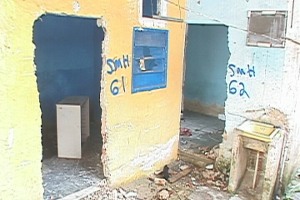
Photo demonstrating the demolition tactics of the municipal government's Municipal Housing Secretary (SMH). Various residents describe the sporadic style of the bulldozings as "minando" (literally, destroying with land mines). The community suspects that this method of eviction was chosen to "smoke out" residents in the remaining homes who have resisted the government's threats and refused to be resettled elsewhere.

The interior of a partially-demolished house. Many houses in Favela do Metro (and most other comunidades) house more than one family on different floors, creating a chaotic removal scheme in which the SMH destroys only the part a house belongs to a family who has agreed to sign eviction papers. In this case, the family occupying the bottom floor has accepted their fate, been relocated, and has had their section of the house bulldozed, whereas the family living upstairs has refused to leave. Residents who remain behind must live with the rubble that the SMH bulldozers leave behind.

Favela do Metro is culturally and physically distinct from the larger and more famous Mangueira comunidade that towers above it. The SuperVia train tracks (pictured) serve as the de facto border between the two settlements.

This home belongs to the young woman with whom I stopped to speak on our walking tour of the community. She watches over her residence night and day to attempt to impede the bulldozers - should they come - from destroying her home. In order to remain in the community during the day, the young woman left her job last February. Note the various "SMH" insignia (in blue) that now deface the facade of her home (explained in detail below)

The blue "swastika" (as dubbed by residents) of the Municipal Housing Secretary. Representatives from the SMH have entered homes in communities slated for removal without permission, and duped residents into signing fate-sealing eviction papers using manipulative and exploitative tactics. In some cases, children have reportedly been forced to sign the papers if their parents are not at home. In other cases, residents have been tricked into thinking the SMH was going door-to-door conducting a survey for the Bolsa Familia social welfare program.


Monday, July 11, 2011

"E so para gringo ver"

Today, President Dilma Roussef announced that the Complexo do Alemao, the sprawling conglomeration of 13 comunidade's in Rio's North Zone, "has everything it needs to become a tourist attraction."

Roussef's remarks come after her inaugural ride on the 6-station teleferico last week. The President expressed pride and hopefulness when asked about the recent Accelerated Growth Program (PAC) upgrading that has taken place in the Complexo since it was occupied by the military last fall, stating:

"O PAC está mudando a vida no Complexo do Alemão. Por isso, para mim foi motivo de orgulho fazer a viagem inaugural do teleférico, passando pelas seis estações do Complexo do Alemão. A subida do morro passou a ser feita com conforto, com segurança e em apenas 15 minutos - disse. - O Complexo do Alemão tem tudo para se transformar em um ponto turístico." "The Program for Accelerated Growth is changing lives in the Complexo do Alemao. So, for me, accompanying the teleferico's first voyage filled me with pride, passing through the six stations of the Complexo do Alema. The climb up the hill can now be done with comfort, security, and within 15 minutes. The Complexo do Alemao has all it needs to become a tourist destination."

One of the 6 teleferico stations in Alemao. All are located on
summits of the hills that comprise the Complexo. Photo credit: R7
Dilma went on to claim that 85,000 people will directly benefit from the installation of the teleferico. Who these 85,000 people will be is anyone's guess. Certainly, they are not the 85,000 residents of the comunidade. And why not, you ask? Well: If you pay a visit to the Complexo to inspect the newly-installed teleferico, you will notice something odd. The six stations Dilma mentions are all located at the summits of hills on which they stand, meaning that a resident who lives toward the middle or bottom of the hill would need to walk all the way up to the top to access the transport system. Is the government truly suggesting that a Complexo resident will embrace the addition of a 20-minute hike (and possibly a BRL $3 expense) to his morning commute, when he could....walk down the hill...for free? Given that the Complexo's hills are already serviced with "moto-taxis" (motorcyle taxis) and "combis" (small privately-owned vans), commuting back up the hill at the end of the day via the teleferico also seems like an unlikely undertaking for a resident. Additionally, a resident of the hill constituting the teleferico's last stop would seemingly have to travel across the six other hills to get to his destination. Would he not opt for a moto-taxi, foot, or combi from the base of his respective hill? Does this commute revision really save him time? Or money?*

In light of the mega-event-related revitalization of Rio's Port Zone, the municipal government is pitching a similar argument in favor of an identical teleferico in the Morro de Providencia. The installation of the teleferico will force the eviction of up to 300 families, prompting further speculation about who the true beneficiaries of the transport system truly are.


Having spoken to residents of both communities, it seems clear that the telefericos will not be used largely among Providencia and Complexo families. Cost, inappropriate positioning of stations, and "e so para gringo ver (it's just for tourists to see) were all cited by residents as proof that the system has not been catered to their needs. Additionally, it is notable that community residents underscore the importance of educational and job opportunities, healthcare access, and proper sanitation over the installation of the teleferico.


E so para gringo ver, indeed.


*in an interview with leading political scientist Maria Helena Moreira Alves, I was informed that Providencia residents will have free access to the teleferico only for the initial two months after the inauguration.

Friday, July 8, 2011

On "environmental sustainability" and housing rights

Yesterday, I was walking home from the gym with my fiance. We got to talking about my research here, which is always a contentious topic for the two of us. Like many middle to upper class Brazilians, my fiance has a deeply ingrained bias against the comunidades and their residents. As you are well aware by now, I have little tolerance for this sort of anti-urban poor mentality. On this particular occasion, we began to butt heads over the environmental argument in favor of evictions. "Favelados* desmatam!" my fiance scoffed. "Favela-residents deforest!" In a dramatic flourish, he then flung his gum wrapper into the canal that parallels our street.

The hypocrisy of his statements and actions speak for themselves. Sure, comunidade residents deforest and pollute. But, don't we all, in a way? Just because a construction company - and not I - felled the trees to build my home in New Orleans, does that abscond me of blame for having deforested the land? Or do I get off scott-free because I'm not residing on it "illegally"? How can a "legal" resident like my fiance accuse an "illegal" resident of polluting, and then proceed to toss his trash in a river? These are the sorts of questions that our short-lived discussion prompted me to explore. Let's take a look:

Up until the 1970s, the policies and programs of major multilateral lending agencies failed to incorporate human impact on the environment in their agendas. "Development" and "environmental preservation" were considered incompatible goals, and rapid industrialization was viewed as the primary means of bolstering economic growth. In Brazil in particular, import-substitution industrialization (ISI) encouraged the city-centric model of growth, and migrants from the rural Northeast began their mass exodus to the Southern metropolises of Sao Paulo and Rio de Janeiro. The height of the ISI model in the mid-1960s also marked the peak of the immigration wave. Comunidade growth rates outpaced those of overall urban growth rates by as much as 7%, and by the end of the decade Rio de Janeiro had over 300 informal settlements. Because zoning regulations had prohibited construction at elevations above 100m, Rio's hillsides were largely undeveloped and became the logical settlements for rural migrants. Initially, the state government paid little mind to the environmental impacts of both industrialization and precarious urbanization. The result was an increasingly polluted city for which comunidade residents would increasingly bear the blame. Comunidades were seen as hotbeds of hygienic and environmental disaster, whose residents were responsible for creating the "subhuman" conditions in which they were condemned to live. Few subscribers of the view that comunidades were ulcers marring an otherwise pristine cityscape were cognizant of the fact that the proliferation of informality was an innovative response to a metropolis incapable of and unwilling to absorb the influx of migrants.

The interconnectedness of the environment, politics, urban planning was not articulated in earnest until the late 1970s, with the rise of the Green Revolution. The product of increased awareness of the inverse relationship between population growth and the abundance of natural resources (see: 1973 oil crisis), the Green Revolution has made significant, irreversible contributions to the field of international development. Today, one would be hard-pressed to find a post-1980 World Bank project, government grant proposal, or UN Charter that does not include the phrase "environmental sustainability." Ostensibly, the establishment of international and domestic standards for environmental preservation is a positive development, as it has become increasingly clear that human strain on the planet jeopardizes the future of the human race.

The Green Revolution has suggested that development and environmental sustainability are not mutually exclusive, and that countries should therefore embrace "green" development over "brown" development. But what does "environmental sustainability" actually imply? What are the benefits and consequences of "environmentally sustainable" development? Is there any segment of the population that may not benefit from environmental regulations?

In the case of Rio, the answer to this last question is, unfortunately, yes. This is not to suggest that environment-friendly policymaking has an inherent, unavoidable bias against a certain group of individuals. However, the trendiness of "environmental sustainability" in Brazil coupled with its predominantly middle and upper-class proponents makes it an excellent rationale for forced evictions. Using the guise of "environmental risk," as outlined in the Lei Organica do Municipio, the municipal government can thereby harness support of Cariocas like my fiance, who believe that "favelados" degrade, pollute, and destroy.

The problem is, this argument is both hypocritical and discriminatory. Let's once again consider the case of Vila Autodromo, a community slated for removal because of its "environmental risk." What is the difference between the comunidade resident who constructs his humble, self-built home on Lake Jacarepagua, and the resident of a 20-story "legal" condominium some 500 meters away? Both constructions are located within the same radius  from the water's edge, both required some degree of deforestation, and both produce some degree of water-borne pollution. Yet, invariably, the "illegal" resident gets stuck with the blame, despite the fact that in most cases, his house predates the "legally" constructed condominium.

May 29th, 2011 storm that damaged the coastal boundaries
of  wealthy Zona Sul neighborhoods.
Photo credit: itapoapordentro.blogspot.com
Furthermore, the "environmental risk" clause is vague in nature. Who poses the risk to whom? Do the comunidade residents pose a risk to themselves, or to the "legal" residents of the surrounding "formal" neighborhoods? The municipal government's decision to raze Autodromo appears to have been predicated on latter; Autodromo's inhabitants have been accused of polluting the lake and deforesting the surrounding area, thereby sullying the region for the "legal" residents. The environmental hazards Autodromo residents confer upon themselves are negligible; the area has not experienced any significant flooding in residents' memory, natural soil filtration is used to purify sewage, and community's flat terrain presents zero risk for a landslide. If the municipal government is truly concerned about "environmental risk," perhaps they should consider relocating the wealthy neighborhoods of Ipanema, Arpoador -which are projected to be the areas most adversely affected by rising sea levels. 

The use of the environment to further criminalize informality seems even more dubious when one considers the average carbon footprint of a comunidade resident. They use public transportation, bicycles, and foot to commute. Cooling is usually provided by fans, not central air. Light, electricity, and water use is kept to a minimum. Yet, it's perfectly acceptable for the upper class Carioca who chastizes "aqueles favelados" for putting strain on the environment to hop in his car (despite living in an area well-serviced by mass transit), blast the AC, and drive home to his condominium where he will be greeted by a water-guzzling fountain illuminated by 24-hour exterior lighting. This sort of "fair-weather environmentalism" is hypocritical and self-serving; as Edesio mentioned this week in class, "I wonder what percent of Cariocas who clamored for the construction of "eco-limit" walls around Dona Marta have ever set foot in the Tijuca Rainforest preserve."

Lastly, it is abhorrent that the municipal government is insinuating that "environmental sustainability" should be prioritized over housing, livelihoods, and the preservation of social networks for comunidade residents. The hierarchy of needs of Eduardo Paes does not mirror the hierarchy of needs of someone living in Vila Autodromo, and the right to four walls and a roof trumps the prefeitura's right to reconstruct Rio de Janeiro as a playground for the wealthy and the powerful.

I pollute. I have contributed to deforestation. And I have definitely peed in a lake. But, because I am not living informally, I have not been criminalized for my actions. Until the municipal government and its clientelistic elite cronies agree to share the blame for environmental degradation, and until they cease to use the it as an excuse to forcibly evict, I will refuse to subscribe to their definition of "environmental sustainability."


*This is a pejorative term for a comunidade resident

Wednesday, July 6, 2011

The Incredible Hypocrisy of Everything

Some people have a talent for framing the obvious in a way that makes it seem novel. In class today, Edesio verbalized a hypocrisy of Rio's urban landscape that I had never considered: the fact that city's mitochondria - the "informal" landholders - helped build Rio de Janeiro from the ground up, but are prohibited from exercising their "right to the city".

What did Edesio mean by this? The case of Favela do Metro, which I visited today, serves as the perfect paradigm for Edesio's theory.

Favela do Metro, as seen from Av. Marechal Rondon. Note that Metro is
physically separated from Mangueira by the traintracks.
Photo credit: O Globo
Favela do Metro, lies on thin strip of land straddled by Avendia 24 de Maio on one side, and the SuperVia train tracks on the other. At first glance, it appears that Favela do Metro is a row of ground-level structures comprising the foot of the massive hillside Mangueira comunidade (see photo, left). In fact, Favela do Metro is its own separate neighborhood, with a different past, and a very different fate than its upstairs neighbor.


Unlike Vila Autodromo, Favela do Metro residents live on privately-owned land. This is somewhat unusual tenure situation for a comunidade in Rio, and it has its roots in the construction of the second line (Linha 2) of Rio's metro system. When work on the new line began in the late 1970s, cheap labor was brought into the city from the countryside by the now privately-held MetroRio. These migrant workers were not provided with on-site housing, and thus constructed their own makeshift homes on a nearby plot of land. When the project was completed, some workers abandoned the area and returned to the country, while others remained and converted the flimsy structures into more permanent housing. Vacant houses were either occupied by "invasores" ("invaders"), or purchased outright on the informal market from their original owners.


Favela do Metro is currently undergoing a process of forced eviction by the municipal government in preparation for the Olympic Games and the World Cup. Because of its extreme proximity to Maracana, which will host the soccer matches for both events, Metro lies within the "security perimeter" that the municipal government is establishing around the stadium. Although the Municipal Housing Office's (SMH) official rationale for the community's removal has been vague, the generally accepted belief among Metro residents is that the government does not want tourists to come face-to-face with the realities of poverty. The solution, therefore, is to once again esconder a sujeira debaixo da tapete - literally, "hide the dirt under the rug".


As in Vila Autodromo (see last month's series of post on this community's struggle), the SMH entered Favela do Metro and grafittied the facades of each house with their blue insignia. Residents were forced to sign papers confirming the expropriation of their houses by the government, and were told to make a split-second decision regarding their fates: accept, or decline, the government's compensation proposal.


Many accepted. Of approximately 900 original families, community leader Franci tells us, nearly half have already left Favela do Metro. Most have gone either to Minha Casa Minha Vida housing projects in Cosmos. Let me take this opportunity to remind you that it is common knowledge that the Cosmos projects are dominated by the militia, poorly-served by public transportation and more than 50km away from Favela do Metro. Other families have been relocated to the nearby Mangueira 1 residence, a social housing project provided via the state's Morar Carioca (Live Like a Rio-Dweller) iniative. We visited Mangueira 1 together with Franci after she led us on a walking tour of Metro. Mangueira 2 (identical to Mangueira 1), is being constructed nearby, and will house any remaining Metro residents who agree to sign the government's eviction papers. While Franci says Mangueira 1 is "highly preferable" to Minha Casa Minha Vida housing, she underscores that the best option would be for residents to remain right where they are. It should be noted here that unlike some other evictees, Favela do Metro residents are not compensated financially, and instead are offered housing in the Mangeuira or Minha Casa Minha Vida residences in exchange for their homes. Although the municipal government promised residents that they would subsidize rent in both Minha Casa Minha Vida and the Mangueira residences, Franci tells me that this money has yet to materialize. Instead, displaced residents are paying rent and utilities out of their own pockets.


And what of residents who do not view Minha Casa Minha Vida nor Mangueira 1 apartments as a fair trade for their current homes? What of residents who refused the government's quid pro quo? These residents - some 300 families - have remained in Favela do Metro, watching over there homes day in and day out with the hope that their on-site presence will preclude the destruction of their homes by the SMH. They have refused to bow to government, and will not accept relocation to Minha Casa Minha Vida as an option. As Mangueira 2 is only scheduled to be completed in November, the prospect of homelessness looms for these families; Franci informed us that the SMH has threatened to bulldoze the remaining homes as early as this weekend.


On our walk, we see a young woman standing alone in a field of rubble. Her gaze is set on the one home in our field of vision that remains standing; a two-story brick house nestled under an overpass. Newly-stray cats and dogs (Minha Casa Minha Vida housing prohibits pets) circle her feet, hoping for a handout.


We stop to talk to her. I ask her how long she has been here. I meant today, now, standing here alone. She interprets my question differently. "Since January", she says. She appears to acknowledge my quizzical eyebrow-raise, and adds, "I left my job in January to stay and watch over the house, so that they [the SMH] don't come and destroy it". She goes on to explain that although her family has accepted the government's resettlement offer and has moved to Mangueira 1, she still wants to keep a watchful eye on the home she left behind. I ask her where she will go when her house is demolished. "Talvez Mangueira," she says. "Maybe Mangueira (the comunidade). "Sei la," she adds. "I don't really know".


I press her for more details on the living conditions at Mangueira 1. Overall, she says, it is "okay". The biggest downfall is that regardless of size, families receive the same size unit, which consists of two rooms and a kitchen area. While the Mangueira units may be an upgrade in terms of size for some, many comunidade families had at least 6 members living in the same house (often with two or more stories). For these families, the move to Mangueira has resulted in severely cramped living quarters.


We continue our walk.


I had always assumed that evictions take place quickly, completely, and thoroughly. Bulldozers enter, knock down all of the "informal" structures, and leave. This has not been the case in Favela do Metro; much to the contrary, the SMH has adopted a strategy of what Metro residents call "minando" - literally "land-mining". "Minando" is the real-world manifestation of the children's game of Battleship, in which a player destroys his opponent's boats one at a time with the objective of eventually dismantling the entire fleet. In Battleship, there is no fun to be had in bombing all of your enemy's boats at once; the game would end quickly and there would be a fuss. Similarly, instead of taking out Favela do Metro in one fell swoop, the SMH has chosen to demolish only a handful of houses with each bulldozing. In some instances, homes have been left half-standing, with one side completely destroyed and the other perfectly intact. Why? Because - like Battleship - there is a certain appeal in backing your enemy into a corner and forcing him to surrender. Apart from making one's victory all the more gratifying, the "minando" strategy has the added benefit of having a "smoking out" effect on any residents who refuse to cede their homes.


How does this "smoking out" strategy manifest itself in Favela do Metro? It's not pretty, I can tell you that. What I saw this afternoon was nothing short of appalling. Mounds of rubble left behind by SMH bulldozers have created squalid conditions for the remaining residents. Cockroaches, rats, and mosquitoes can be seen swarming around the gaping holes in the ground where houses used to stand. The air reeks of human waste, the result of what Franci describes as "crackheads" using the half-demolished houses as drug dens. As the rubble pile-up has interfered with water drainage, ominous, algae-filled puddles have appeared on the sides of the becos - breeding grounds for dengue and leptospiorsis. The rubble-piles have also become the area's de-facto landfill, as other parties have taken to dumping their own trash on top of the heaps of wreckage.


There is also the issue of security. Franci brings us to the house of Eomar Freitas, one of the residents who has chosen to remain behind to watch over his home. I assume that, like the young woman we spoke to earlier in the visit, he means that he thinks his physical presence in the house will preclude an SMH bulldozing. He corrects me. He keeps watch over his home to dissuade potential thieves. "I've been robbed five times in five months," Eomar explains. "They took speakers, the air conditioner - even a glass window from the wall!" Eomar is not sure who is responsible for the theft of his property, but he is positive that the collapse of security within the community is due to the sporadic eviction process. "This place is a ghost town now, no one is left on the streets," he laments, adding that Metro never had a problem with breaking and entering prior to the SMH bulldozings. Eomar ends his diatribe by telling us that he sleeps in his empty house (his family has moved many belongings elsewhere, but what they left behind has been stolen), alone, every night.


Like Vila Autodromo's situation, Favela do Metro's eviction is laden with questionably legal justifications. But unlike Vila Autodromo, Favela do Metro residents do not hold title deeds, and they do not live on public land. This renders their legal case against removal different in nature, because by Brazilian law, informal residents occupying privately-held land cannot petition for concession of real right to housing (a legal instrument Brizola may have leveraged in order to grant titles to Autodromo residents). Instead, Metro residents wishing to file a lawsuit would have to try to win on the grounds of usucapiao - or adverse possession granted after 5-15 years of "illegal" occupation of private land. Usucapiao is notoriously difficult to demonstrate in court. Given that the municipal government mysteriously "re-assigned" public defenders assigned to communities threatened by removal, the chances of a successful class action lawsuit look slim.


After the visit was over, I walked back toward the metro station with another researcher. I thought about what Edesio had said in class, about the city's hypocritical exclusion of those who keep it running. I felt a pang of guilt, realizing that I had just visited a community which made possible the very transport system that had brought me to see it. A community of rail workers, maids, bus drivers, doormen. A community now being exiled from the very city it helped to create and continues to sustain.

Tuesday, July 5, 2011

CPI das Remocoes (Parliamentary Eviction Investigation) update

Today, in "head, meet desk" news:

The vote in the Camara Municipal last week in favor of a judicial investigation (CPI) into the legality of mega-event-related forced removals has been overturned. Why? Because apparently, five of the city council members rescinded their signatures from the CPI petition, on the grounds that they "did not read it".

Undocumented reading disabilities, or clientelism? You be the judge.


Friday, July 1, 2011

Some final words on the forced removal of Vila Autodromo (Part 6 of 6)

“Sweeping Dirt Under the Rug”
The consequences of forced evictions have been widely publicized. Amnesty International, UN-HABITAT, and the Coalition on Housing Rights and Evictions (COHRE) have all released numerous reports directly linking evictions to the replication of poverty.
Families rendered homeless by South African World Cup
evictions. Photo Credit: Reuters
In post-World Cup South Africa, evictees were stripped of their livelihoods and saddled with unemployment. In the case of Rio de Janeiro, a city which lists poverty eradication as one of its top goals, the evidence that forced removals promote the reproduction of poverty should be cause for concern. Instead, Paes’ short-sighted policies ignore the economic argument against razings and embrace removals and poorly- compensated relocations, despite the documented objections of the aforementioned international organizations. Residents refer to this untenable method of confronting poverty as an attempt to “esconder sujeira debaixo do tapete” (“sweep dirt under the rug”), an idiom tailor-made for describing the government’s efforts to obscure the unglamorous reality of poverty from the watchful gaze of FIFA, the IOC, and the media.

In cases where evictees are provided with subsidized Minha Casa Minha Vida housing, only the cost of monthly rent is assumed by the government. Evictees are expected to contribute a “symbolic fee” of $50 Brazilian reais per month toward the purchase of a home which, in many cases, is in inferior in quality to their previous residences. Of course, this fee does not include any additional monetary imposition placed upon residents by the militia in exchange for utility provision (in one case, reported to be in excess of $100 reais) and “protection1.” When one considers the economic and social costs of relocating to a Minha Casa Minha Vida residence, it comes as little surprise that some residents have already sold their units and moved out. However, it has been anonymously reported that the militia also extort a 20% “sales tax” from any resident who wishes to vacate his or her apartment2 With a lack of affordable housing options and little left in their pockets after effectively financing their own relocation, it is likely that those who abandon the apartments will either resettle in other informal settlements or create entirely new ones. Clearly, such a relocation strategy contributes to - rather than combats - poverty.
In one of the worst possible examples of the government’s failure to provide adequate housing options to its residents, 74 families were driven from their Minha Casa Minha Vida apartments in the West Zone of Rio by the militia, with the apparent aim of reselling the units and pocketing the profits. Where the 74 families rendered homeless by the militia have gone is unclear.
Fatal landslides in the Serrana Region. Photo credit: UOL

The Fallacious “Risk” Argument
While the government continues to carry out evictions predicated on the “environmental risk” clause, the 840 deaths caused by the recent landslides in Rio’s mountainous Serrana region call into question the true motives behind mega-event-related removals. The Serrana disaster was an instance of real, demonstrated environmental risk, and one that also could have been avoided had the government acknowledged the precarious location of the region’s hillside comunidades and provided safer housing options. That the government instead has chosen to allocate funds and resources to removing communities such as Vila Autodromo - which lies on flat and has not had a significant flood in residents’ memory - while simultaneously failing to take measures to prevent the biggest climate-related disaster in Brazilian history is an unconscionable hypocrisy.

A Final Word
Toward the end of my visit to Vila Autodromo, community leader Jane tells me that the residents are not categorically opposed to relocation, nor the mega-events that their city will host. Rather, she explains, they are against the municipal government’s top-down removal process that fails to consider the voices of the affected residents and manipulates the laws designed to protect them.
The stories relayed to me residents of several different communities facing removal corroborate Jane’s accusations. They include allegations of zero-notice removals, children forced to sign evictions papers when adults are absent, relocations to areas up to 50km away, verbal abuse and physical threats, and unfulfilled promises of compensation. As professor Christopher Gaffney explains, the mega-event preparation is “very authoritarian, top-down, with no public audiences, no democratic participation - and it’s going to change the city forever.”
For the Seu Franciscos of the city, it seems like the changes will be for the worse.


1. A resident of a Minha Casa Minha Vida apartment, who wished to remain anonymous, quoted a price of BRL $15/month for 
   the milicia's "security tax"
2. The same resident quoted the 20% “sales tax” figure in the same interview

Thursday, June 30, 2011

Excellent series of video shorts from NYC-based NGO

NYC-based NGO Witness came to Rio recently to compile short documentaries on the forced removals. Filmed in four different comunidades, the videos paint a vivid picture of the reality of residents who have been - or soon will be - evicted.

The subtitles are in English, and are accurate.


Some good news

This Wednesday during a session at the Camara Municipal, something unexpected happened. The city council voted in favor of a legal investigation - called a CPI - of mega-event related evictions.

Spearheaded by populist council member Eliomar Coelho (PSOL), the CPI (an investigation led by the legislative branch) vote is a critical step in formally calling into question the legality of the removals. 19 city council members - or nearly half those who were present - voted in favor of a CPI of the comunidade evictions. As only 17 votes were necessary to instate the CPI, the two additional "pro" votes demonstrate that there may be significant opposition to the removals within the council.


A [somewhat blurry] photo of us in the Camara Municipal.
Photo credit: Nelma Gusmao
In addition to investigating the legal framework used to justify the evictions and relocations, the CPI will, according to Coelho, examine removals which may violate cultural rights (for example, the destruction of Candomble houses in Vila Harmonia) and environmental protection legislation.

I attended the city council's Wednesday session together with a cohort of other like-minded researchers, as well as community leaders and residents of Vila Autodromo. We were initially told, upon entry, that such a large group of "protesters" would not be permitted to enter the Camara. On pulling out a camera to videotape our denied entry, however (the vote is open to the public as long as proper ID can be produced for each attendee), the guard at the door immediately rethought his decision. We were allowed in, and seated ourselves on the second-floor balcony. Banners in favor of the CPI and against the removals were unfurled, after initially being told they could not be displayed.

One by one, the city council members took to the stand to present their rationale for or against the CPI. Several speeches provoked thunderous applause and cries of approval from the balcony. In particular, Sonia Rabello (PV), Theresa Bergher (PSDB), and Coelho were received extremely positively by the community residents present.

Despite the currents of excitement, hope, and pride which ran through the auditorium after those on the balcony were informed that the council had voted in favor of the CPI, community leaders have some reservations. As Jane Nascimento explained to me when I visited her in Vila Autodromo the day after the vote, many worry that the final few council members who signed the petition may have done so solely for the purpose of securing comunidade votes in future municipal elections. Besides a possible lack of resolve among the final signatories, Nascimento also fears that the corruption endemic among the ranks of the municipal government might preclude a thorough investigation.

Interestingly, Leonel Brizola Neto (PDT), the eponymous grandson of the progressive ex-governor who granted Vila Autodromo its titles, voted against the CPI.

If you want to read more about the investigation (and can read a lick of Portuguese), Coelho lays out his brainchild in detail on his personal website, here.

Monday, June 27, 2011

A la carte law

Unlike many other comunidades, which were built on steep
hillsides, Autodromo occupies a flat swatch of land.
Flood risk is minimal. Photo credit: Globo Esportes
Part 4 in a 6-part series on the removal of Vila Autodromo

Yesterday, an article was published in O Globo stating that every day, Brazil signs 18 new pieces of legislation into law, the majority of which fall to the cutting-room floor and are never leveraged by the judicial system. The City Statute of Rio de Janeiro - a collection of laws designed to reduce urban inequality - is laden with these forgotten decrees, especially those which protect the tenure of residents of informal settlements. As UN Special Rapporteur on Adequate Housing Raquel Rolnik points out, a legal instrument called Zonas Especias de Interesse Social (Zones of Special Social Interest, or ZEIS), permits the designation of buildings in city centers - rather than on the infrastructure-devoid periphery - for those who must be rehoused. However, rather than invoke these laws, which would clash with the interests of powerful real estate moguls and politicians, it appears that mayor Eduardo Paes is selectively drawing upon legislature which can be exploited to justify the community bulldozings without regard to equitable relocations -such as Article 429.

The case of Vila Autodromo is illustrative of the municipal government’s anti-urban poor bias that - with the exception of ex-governor Leonel Brizola’s progressive land titling program in the mid-90s - has largely undermined efforts to establish more just housing policies. Vila Autodromo itself was a beneficiary of Brizola’s de Soto-style initiative, which granted legal tenure to most of the comunidade’s residents in 1994. However, Paes has since informed citizens of Autodromo that these titles “have no value” and that, in accordance with Article 429, Vila Autdromo’s removal is justified due to the community’s location in an area of “environmental risk”. Even if the titles were insufficient to secure tenure, the very same legal system that Paes exploits to lend credence to the “risk” argument also extends case-based legality of tenure to communities with 20 or more years of existence - known in legal terms as usucapiao - rendering the decision to remove Autodromo all the more dubious.

While the argument could be made that a certain amount of deforestation and pollution is necessary for Autodromo’s existence, the determination of “environmental risk” appears to be another example of the law only applying to the city’s poor and powerless – tellingly, the erection of residential high-rises and the Olympic Park press on without incident less than a quarter mile from where Autodromo lies. The double-standards do not end with the questionably-placed construction; part of the government's case against Autodromo has been the waterborne pollution the community allegedly generates. However, on our walking tour of the community, Jane refutes this claim. “Most of the houses here have simple soil filtration systems,” she explains. “The water undergoes natural filtration through the ground before it runs off into the lagoon.” Ironically, Jane points out, sewage from many of the recently-built luxury apartment buildings nearby is dumped directly into the water, untreated.

Another smoking gun has appeared in the course of the Autodromo controversy; the government’s justifications for the comunidade’s removal are constantly changing in response to mounting evidence against them. On top of the environmental risk argument, residents were initially told that their homes had to be demolished to cede the land to the Olympic Media Center. However, several months later, the government revised these plans and announced that the
Media Center would be moved to the Port Zone in the city center. Lacking any other clear-cut reason to remove Autodromo, Eduardo Paes then announced that the community would need to be removed to establish a “security perimeter” around the proposed Olympic venues. However, the question as to why it is permissible to allow residential apartments to remain around the periphery of the Olympic construction, but not a peaceable, working-class community, remains unanswered.

The political hypocrisies do not end there. Incidentally, the municipal government has begun a massive overhaul of the city’s dilapidated Port Zone, centrally located in the city’s appropriately named “Centro” area. The Centro, once a bustling, well-heeled neighborhood, is now replete with abandoned, decaying buildings badly in need of restoration. The government plans to renovate these buildings; however, instead of using them to re-house citizens displaced from their homes by mega-event construction as originally planned, and as ZEIS permits, the buildings will now be repurposed solely for private commercial means, precluding the relocation of residents in homes close to infrastructure, jobs, and transportation hubs.

Sunday, June 26, 2011

Analogy fail.

This weekend, O Globo quoted mayor Eduardo Paes as saying that the restorations in Rio's Port Zone are comparable to the Olympic-related upgrading in East London.* Seemingly, this comparison was based on the fact that both restorations are taking place in "degraded neighborhoods". Yes, folks, the similarities are almost overwhelming!

No, in fact, they are not. The similarities end right there. Let's take a look at a few things East London and the Port Zone revival projects definitely DO NOT have in common. Behold:

London has designated nearly half of its Olympic Village housing units for low-income occupation after the Games. Does that compare to the forced removals of comunidade residents in the Port Zone (see: Providencia)? Does that compare to not offering to re-house these families in anything remotely on-par with an Olympic Village apartment?

Is East London also installing some sort of tourist-oriented teleferico that no one who lives in East London will actually use? Will East London's teleferico also necessitate removing some of the city's poorest residents so that gringo tourists can enjoy a scenic view?


The jokes write themselves, my friends.

*Paes also failed to correctly name the region of London in question. In fact, he said "West Zone" of London.


The Case of Vila Autodromo


Part 3 in a 6-part series on the forced removal of Vila Autodromo

Vila Autodromo, located in the expansive West Zone of the city, is one the comunidades whose permanency is being threatened by the SMH. On October 9th, 2009, Mayor Eduardo Paes called for the complete removal of the comunidade to make way for the Olympic Park, a BRL $37 million “leisure area” for Games
The Azure Letter. Houses marked for removal
in Autodromo. Photo credit: RioOnWatch
athletes that will also serve as the site of this year’s Rock in Rio music festival. Home to Seu Francisco and approximately 3,000 other residents, Vila Autodromo boasts more than 40 years of peaceful existence, free of the drug trafficking and violence that plague the vast majority of Rio’s other informal settlements.

I had the privilege of visiting Vila Autodromo last week to meet with community leader Jane Nascimento, who has been instrumental in the community’s fight against an otherwise sealed fate. Although the community was scheduled to be removed in March, the SMH has been unable to bulldoze a single house, thanks in part to Nascimento’s vociferous opposition. “They [the SMH ] have tried to come here a few times with their bulldozers,” she tells me. “But we have resisted. We blockade the roads, and they cannot enter.”
That same day, Jane leads me and a group of other independent researchers on a walking tour of Vila Autodromo. It is not difficult to see why the government is interested in this swatch of prime real estate, marking its territory with the now-infamous blue grafitti the SMH uses to deface the facades of houses it will soon remove. Peppered with lush vegetation, Autodromo is flanked by a main boulevard on one side and the lagoon on the other, and boasts top-notch views of the massive body of water. In order to legally remove the community, however, the government must navigate through a series of articles in the City Statue designed to protect land tenure for all but the most precarious settlements. One legal instrument is Article 429, the Lei Organica do Municipio, which stipulates that removal is only justified when an informal settlement occupies a tract of land that “poses a signficant risk to its residents.” This wording leaves some room for ambiguity in its definition of “significant risk”, and indeed it is this exact piece of legislation that is being manipulated by the municipal government in order to authorize the forced evictions. The SMH has recently cited “pollution” and “flood risk” as reasons for Vila Autodromo’s removal despite the fact that residents are hard-pressed to remember the last time the community had a flood, and that most of the water-borne pollution comes from other residential areas surrounding the lagoon, as Seu Francisco described.
Jane goes on to express her fear that, despite the community’s past success in thwarting demolition (the community was scheduled to be removed in March of this year), the SMH may soon begin bulldozing houses, businesses, and the newly erected community church. Particularly, she worries that residents will be relocated to the militia-controlled Minha Casa Minha Vida apartments, which offer little in the way of amenities – much less a community-built place of open worship. Jane explains, “If we are relocated, we want everything that we have here, there [in the Minha Casa Minha Vida complex].”