Showing posts with label lei organica. Show all posts

Monday, June 27, 2011

A la carte law

Unlike many other comunidades, which were built on steep
hillsides, Autodromo occupies a flat swatch of land.
Flood risk is minimal. Photo credit: Globo Esportes
Part 4 in a 6-part series on the removal of Vila Autodromo

Yesterday, an article was published in O Globo stating that every day, Brazil signs 18 new pieces of legislation into law, the majority of which fall to the cutting-room floor and are never leveraged by the judicial system. The City Statute of Rio de Janeiro - a collection of laws designed to reduce urban inequality - is laden with these forgotten decrees, especially those which protect the tenure of residents of informal settlements. As UN Special Rapporteur on Adequate Housing Raquel Rolnik points out, a legal instrument called Zonas Especias de Interesse Social (Zones of Special Social Interest, or ZEIS), permits the designation of buildings in city centers - rather than on the infrastructure-devoid periphery - for those who must be rehoused. However, rather than invoke these laws, which would clash with the interests of powerful real estate moguls and politicians, it appears that mayor Eduardo Paes is selectively drawing upon legislature which can be exploited to justify the community bulldozings without regard to equitable relocations -such as Article 429.

The case of Vila Autodromo is illustrative of the municipal government’s anti-urban poor bias that - with the exception of ex-governor Leonel Brizola’s progressive land titling program in the mid-90s - has largely undermined efforts to establish more just housing policies. Vila Autodromo itself was a beneficiary of Brizola’s de Soto-style initiative, which granted legal tenure to most of the comunidade’s residents in 1994. However, Paes has since informed citizens of Autodromo that these titles “have no value” and that, in accordance with Article 429, Vila Autdromo’s removal is justified due to the community’s location in an area of “environmental risk”. Even if the titles were insufficient to secure tenure, the very same legal system that Paes exploits to lend credence to the “risk” argument also extends case-based legality of tenure to communities with 20 or more years of existence - known in legal terms as usucapiao - rendering the decision to remove Autodromo all the more dubious.

While the argument could be made that a certain amount of deforestation and pollution is necessary for Autodromo’s existence, the determination of “environmental risk” appears to be another example of the law only applying to the city’s poor and powerless – tellingly, the erection of residential high-rises and the Olympic Park press on without incident less than a quarter mile from where Autodromo lies. The double-standards do not end with the questionably-placed construction; part of the government's case against Autodromo has been the waterborne pollution the community allegedly generates. However, on our walking tour of the community, Jane refutes this claim. “Most of the houses here have simple soil filtration systems,” she explains. “The water undergoes natural filtration through the ground before it runs off into the lagoon.” Ironically, Jane points out, sewage from many of the recently-built luxury apartment buildings nearby is dumped directly into the water, untreated.

Another smoking gun has appeared in the course of the Autodromo controversy; the government’s justifications for the comunidade’s removal are constantly changing in response to mounting evidence against them. On top of the environmental risk argument, residents were initially told that their homes had to be demolished to cede the land to the Olympic Media Center. However, several months later, the government revised these plans and announced that the
Media Center would be moved to the Port Zone in the city center. Lacking any other clear-cut reason to remove Autodromo, Eduardo Paes then announced that the community would need to be removed to establish a “security perimeter” around the proposed Olympic venues. However, the question as to why it is permissible to allow residential apartments to remain around the periphery of the Olympic construction, but not a peaceable, working-class community, remains unanswered.

The political hypocrisies do not end there. Incidentally, the municipal government has begun a massive overhaul of the city’s dilapidated Port Zone, centrally located in the city’s appropriately named “Centro” area. The Centro, once a bustling, well-heeled neighborhood, is now replete with abandoned, decaying buildings badly in need of restoration. The government plans to renovate these buildings; however, instead of using them to re-house citizens displaced from their homes by mega-event construction as originally planned, and as ZEIS permits, the buildings will now be repurposed solely for private commercial means, precluding the relocation of residents in homes close to infrastructure, jobs, and transportation hubs.

Sunday, June 26, 2011

The Case of Vila Autodromo


Part 3 in a 6-part series on the forced removal of Vila Autodromo

Vila Autodromo, located in the expansive West Zone of the city, is one the comunidades whose permanency is being threatened by the SMH. On October 9th, 2009, Mayor Eduardo Paes called for the complete removal of the comunidade to make way for the Olympic Park, a BRL $37 million “leisure area” for Games
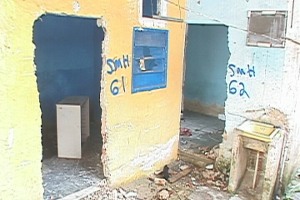
The Azure Letter. Houses marked for removal
in Autodromo. Photo credit: RioOnWatch
athletes that will also serve as the site of this year’s Rock in Rio music festival. Home to Seu Francisco and approximately 3,000 other residents, Vila Autodromo boasts more than 40 years of peaceful existence, free of the drug trafficking and violence that plague the vast majority of Rio’s other informal settlements.

I had the privilege of visiting Vila Autodromo last week to meet with community leader Jane Nascimento, who has been instrumental in the community’s fight against an otherwise sealed fate. Although the community was scheduled to be removed in March, the SMH has been unable to bulldoze a single house, thanks in part to Nascimento’s vociferous opposition. “They [the SMH ] have tried to come here a few times with their bulldozers,” she tells me. “But we have resisted. We blockade the roads, and they cannot enter.”
That same day, Jane leads me and a group of other independent researchers on a walking tour of Vila Autodromo. It is not difficult to see why the government is interested in this swatch of prime real estate, marking its territory with the now-infamous blue grafitti the SMH uses to deface the facades of houses it will soon remove. Peppered with lush vegetation, Autodromo is flanked by a main boulevard on one side and the lagoon on the other, and boasts top-notch views of the massive body of water. In order to legally remove the community, however, the government must navigate through a series of articles in the City Statue designed to protect land tenure for all but the most precarious settlements. One legal instrument is Article 429, the Lei Organica do Municipio, which stipulates that removal is only justified when an informal settlement occupies a tract of land that “poses a signficant risk to its residents.” This wording leaves some room for ambiguity in its definition of “significant risk”, and indeed it is this exact piece of legislation that is being manipulated by the municipal government in order to authorize the forced evictions. The SMH has recently cited “pollution” and “flood risk” as reasons for Vila Autodromo’s removal despite the fact that residents are hard-pressed to remember the last time the community had a flood, and that most of the water-borne pollution comes from other residential areas surrounding the lagoon, as Seu Francisco described.
Jane goes on to express her fear that, despite the community’s past success in thwarting demolition (the community was scheduled to be removed in March of this year), the SMH may soon begin bulldozing houses, businesses, and the newly erected community church. Particularly, she worries that residents will be relocated to the militia-controlled Minha Casa Minha Vida apartments, which offer little in the way of amenities – much less a community-built place of open worship. Jane explains, “If we are relocated, we want everything that we have here, there [in the Minha Casa Minha Vida complex].”