Showing posts with label olympics. Show all posts

Wednesday, June 29, 2011

The Blame Game

Part 5 in a 6-part series on the removal of Vila Autodromo

While at first glance, the apparent community-razing culprits are Eduardo Paes and the Municipal Housing Office (SMH), all of the blame cannot be placed on Rio’s government. FIFA, which spearheads the World Cup, and the International Olympic Committee (IOC), responsible for the organization of the Olympic Games, are equally guilty of fueling the comunidade removals. The involvement of municipal government in the razings is motivated largely by FIFA and the IOC’s need to ensure revenue from their respective events, as well as guarantee their continued marketability once the events are over. Both of these goals are complicit in the municipal government’s decision to remove certain communities and relocate residents with little or no compensation.

Eduardo Paes and FIFA's General Secretary Jermome Valke.
Photo Credit: O Globo
The ultimate goal of profit generation is the most obvious scapegoat. After all, FIFA and the IOC are, at heart, private enterprises which have the shared goal of walking away from their respective mega-events with a hefty profit. As Alan Maiden, a South African professor of urban planning recently explained in a debate on the impact of mega-events on host cities, FIFA pocketed over $3 billion from last year’s World Cup - nearly half the total profit of the event. In order to guarantee an equally attractive profit in 2014 and 2016, FIFA and the IOC impose strict prerequisites on host cities which ensure a positive consumer experience. Namely, the organizations mandate that a certain number of hotels, tourist venues, stadiums, and transportation hubs be in place prior to hosting the mega-events. In order to execute the massive infrastructural overhaul that these events require, it follows that some residents might have to be relocated. Again, however, it is by and large low-income and informal areas that are the most adversely effected by event-related development. In the much rarer case of forced removal of a “legal” housing unit, compensation is ample and delivered in a timely manner. As Dr. Christopher Gaffney, a visiting professor of urbansim at Rio’s Universidade Federal Fluminense explained to me in a recent interview, “Eduardo Paes has promised to personally deliver monetary compensation to residents with government-honored legal tenure.” In many cases, these residents will emerge with a profit.
The second tie that FIFA and the IOC have to the removals is the desire of both entities to operate within a city which appears clean, non-violent, and poverty-free in international media coverage. This need is almost certainly the rationale for the municipal government’s creation of the aforementioned “security perimeter”, which now serves as the explanation for the removal of Vila Autodromo and countless other comunidades. Even in Atlanta and Vancouver, two Olympic host cities with far lower crime and poverty rates than Rio, security concerns prompted the government’s’ criminalization of poverty and curtailment of human rights as thousands of homeless were driven from the streets in the weeks prior to the Games. In Beijing, a city with a socioeconomic landscape which more closely resembles that of Rio, no less than 800,000 people were reported as having been forcibly evicted during preparations for the 2008 Olympics. It doesn’t take much stretch of the imagination, therefore, to comprehend the scope of mega-event-related evictions that will take place in Rio given the city’s deep-seated global reputation as a hotbed of “squatters”, drug trafficking, and homicide.
No less than 2,800 comunidade evictions have already been reported, most of which have resulted in little - if any - financial compensation for displaced residents. In a city where real estate speculation and an overvalued currency have combined to drive housing prices through the roof, it is difficult to imagine that the maximum reported compensation (roughly US $24,000) will buy an evictee anything short of a cramped tenement incapable of accommodating larger families. Factor in the opportunity cost of missed days at work and moving expenses, and the price of relocation becomes even more out-of-reach for evictees in a city where the minimum wage lags behind the burgeoning real estate market.
In a way, FIFA and the IOC assume the role of a joint, de facto government which encourages Paes’ martial law-style tactics to ensure event revenue and successful legacy marketing. The municipal government - willingly or unwillingly - finds itself at the mercy of these procurators of international sport, lured by the dangling carrot of profit-sharing.

Monday, June 27, 2011

A la carte law

Unlike many other comunidades, which were built on steep
hillsides, Autodromo occupies a flat swatch of land.
Flood risk is minimal. Photo credit: Globo Esportes
Part 4 in a 6-part series on the removal of Vila Autodromo

Yesterday, an article was published in O Globo stating that every day, Brazil signs 18 new pieces of legislation into law, the majority of which fall to the cutting-room floor and are never leveraged by the judicial system. The City Statute of Rio de Janeiro - a collection of laws designed to reduce urban inequality - is laden with these forgotten decrees, especially those which protect the tenure of residents of informal settlements. As UN Special Rapporteur on Adequate Housing Raquel Rolnik points out, a legal instrument called Zonas Especias de Interesse Social (Zones of Special Social Interest, or ZEIS), permits the designation of buildings in city centers - rather than on the infrastructure-devoid periphery - for those who must be rehoused. However, rather than invoke these laws, which would clash with the interests of powerful real estate moguls and politicians, it appears that mayor Eduardo Paes is selectively drawing upon legislature which can be exploited to justify the community bulldozings without regard to equitable relocations -such as Article 429.

The case of Vila Autodromo is illustrative of the municipal government’s anti-urban poor bias that - with the exception of ex-governor Leonel Brizola’s progressive land titling program in the mid-90s - has largely undermined efforts to establish more just housing policies. Vila Autodromo itself was a beneficiary of Brizola’s de Soto-style initiative, which granted legal tenure to most of the comunidade’s residents in 1994. However, Paes has since informed citizens of Autodromo that these titles “have no value” and that, in accordance with Article 429, Vila Autdromo’s removal is justified due to the community’s location in an area of “environmental risk”. Even if the titles were insufficient to secure tenure, the very same legal system that Paes exploits to lend credence to the “risk” argument also extends case-based legality of tenure to communities with 20 or more years of existence - known in legal terms as usucapiao - rendering the decision to remove Autodromo all the more dubious.

While the argument could be made that a certain amount of deforestation and pollution is necessary for Autodromo’s existence, the determination of “environmental risk” appears to be another example of the law only applying to the city’s poor and powerless – tellingly, the erection of residential high-rises and the Olympic Park press on without incident less than a quarter mile from where Autodromo lies. The double-standards do not end with the questionably-placed construction; part of the government's case against Autodromo has been the waterborne pollution the community allegedly generates. However, on our walking tour of the community, Jane refutes this claim. “Most of the houses here have simple soil filtration systems,” she explains. “The water undergoes natural filtration through the ground before it runs off into the lagoon.” Ironically, Jane points out, sewage from many of the recently-built luxury apartment buildings nearby is dumped directly into the water, untreated.

Another smoking gun has appeared in the course of the Autodromo controversy; the government’s justifications for the comunidade’s removal are constantly changing in response to mounting evidence against them. On top of the environmental risk argument, residents were initially told that their homes had to be demolished to cede the land to the Olympic Media Center. However, several months later, the government revised these plans and announced that the
Media Center would be moved to the Port Zone in the city center. Lacking any other clear-cut reason to remove Autodromo, Eduardo Paes then announced that the community would need to be removed to establish a “security perimeter” around the proposed Olympic venues. However, the question as to why it is permissible to allow residential apartments to remain around the periphery of the Olympic construction, but not a peaceable, working-class community, remains unanswered.

The political hypocrisies do not end there. Incidentally, the municipal government has begun a massive overhaul of the city’s dilapidated Port Zone, centrally located in the city’s appropriately named “Centro” area. The Centro, once a bustling, well-heeled neighborhood, is now replete with abandoned, decaying buildings badly in need of restoration. The government plans to renovate these buildings; however, instead of using them to re-house citizens displaced from their homes by mega-event construction as originally planned, and as ZEIS permits, the buildings will now be repurposed solely for private commercial means, precluding the relocation of residents in homes close to infrastructure, jobs, and transportation hubs.

Sunday, June 26, 2011

The Case of Vila Autodromo


Part 3 in a 6-part series on the forced removal of Vila Autodromo

Vila Autodromo, located in the expansive West Zone of the city, is one the comunidades whose permanency is being threatened by the SMH. On October 9th, 2009, Mayor Eduardo Paes called for the complete removal of the comunidade to make way for the Olympic Park, a BRL $37 million “leisure area” for Games
The Azure Letter. Houses marked for removal
in Autodromo. Photo credit: RioOnWatch
athletes that will also serve as the site of this year’s Rock in Rio music festival. Home to Seu Francisco and approximately 3,000 other residents, Vila Autodromo boasts more than 40 years of peaceful existence, free of the drug trafficking and violence that plague the vast majority of Rio’s other informal settlements.

I had the privilege of visiting Vila Autodromo last week to meet with community leader Jane Nascimento, who has been instrumental in the community’s fight against an otherwise sealed fate. Although the community was scheduled to be removed in March, the SMH has been unable to bulldoze a single house, thanks in part to Nascimento’s vociferous opposition. “They [the SMH ] have tried to come here a few times with their bulldozers,” she tells me. “But we have resisted. We blockade the roads, and they cannot enter.”
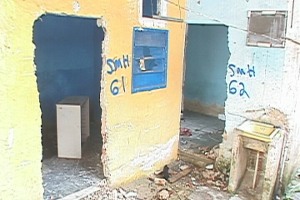
That same day, Jane leads me and a group of other independent researchers on a walking tour of Vila Autodromo. It is not difficult to see why the government is interested in this swatch of prime real estate, marking its territory with the now-infamous blue grafitti the SMH uses to deface the facades of houses it will soon remove. Peppered with lush vegetation, Autodromo is flanked by a main boulevard on one side and the lagoon on the other, and boasts top-notch views of the massive body of water. In order to legally remove the community, however, the government must navigate through a series of articles in the City Statue designed to protect land tenure for all but the most precarious settlements. One legal instrument is Article 429, the Lei Organica do Municipio, which stipulates that removal is only justified when an informal settlement occupies a tract of land that “poses a signficant risk to its residents.” This wording leaves some room for ambiguity in its definition of “significant risk”, and indeed it is this exact piece of legislation that is being manipulated by the municipal government in order to authorize the forced evictions. The SMH has recently cited “pollution” and “flood risk” as reasons for Vila Autodromo’s removal despite the fact that residents are hard-pressed to remember the last time the community had a flood, and that most of the water-borne pollution comes from other residential areas surrounding the lagoon, as Seu Francisco described.
Jane goes on to express her fear that, despite the community’s past success in thwarting demolition (the community was scheduled to be removed in March of this year), the SMH may soon begin bulldozing houses, businesses, and the newly erected community church. Particularly, she worries that residents will be relocated to the militia-controlled Minha Casa Minha Vida apartments, which offer little in the way of amenities – much less a community-built place of open worship. Jane explains, “If we are relocated, we want everything that we have here, there [in the Minha Casa Minha Vida complex].”

Wednesday, June 22, 2011

The Old Man and the Lagoon

Part 1 in a 6-part series on the forced removal of Vila Autodromo

Vila Autdromo on the margins of the Jacarepagua Lagoon.
Photo credit: favela.info
Grizzled, deeply tanned, and with cataracts that fail to obscure a pair of animated green eyes, Seu Francisco is the spitting image of Hemingway’s old fisherman. Like his fictitious Cuban counterpart, Seu Francisco’s life is characterized by his relationship to water. The Jacarepagua Lagoon, where Seu Francisco and 3,000 other residents have made their home, laps languidly at the shore below as he gazes out from his rooftop across the vast expanse of turbid blue. He recalls the days when fish were abundant in the lagoon, and provided him with a sufficient income for his family. He gestures to the opposite shore of the inlet on which his two-story house is perched, and directs my attention to an area of the lagoon where construction for the Olympic Games has begun. “See that? They pollute the water. They cut down trees. They dump their construction waste in the lake,” he explains. “I can’t fish here anymore. Now I must travel two hours to the next lagoon, where there are still fish.”
“What about the fish here?” I ask. “Where are they now?”
Seu Francisco shakes his head slowly. “Sumiram,” he says. “They disappeared.”
Thanks to an October 9th, 2009 decision by the municipal government to bulldoze his home to make way for Games-related construction, Seu Francisco may soon meet the same fate as his fish.

Another UPP, another "victory" for...who, exactly?

On Sunday, the military police (PM) of Rio de Janeiro carried out their "occupation" of Morro da Mangueira, one of the city's most famous comunidades*. This invasion will cinch the "security belt" of UPPs - the 24-hour Police Pacifying Units - that the municipal government has placed around the city's South and Center Zones, with the well-publicized aim of "pacifying" the ten comunidades which lie in close proximity to the Temple of Futbol: Maracana stadium. (Here it should be noted that "pacifying" is a euphemsim for "forcibly expelling drug traffickers").


Note the absence of UPPs (red) in areas far from the city center,
and the belt-like formation around Maracana (yellow).

As Rio will host the World Cup in 2014 and the Olympic Games two years later, it is undeniable that the city has some cleaning up to do. It's difficult to disassemble in a mere 3 years an international reputation of violence, drug trafficking, and poverty that has been snowballing since the late 70s when the Commando Vermelho drug faction formed. Given this insurmountable task, the city government has begun to wage a war on their most marginalized residents, criminalizing poverty and robbing comunidade residents of their homes, culture, and livelihoods. Mostly, I will be discussing the evictions and relocations of the 1.5 million-odd Cariocas who are estimated to be displaced by comunidade razings in the years leading up to these two mega-events. Today, however, I am talking about the PM's installation of the UPPs, a less sinister form of urban cleansing, but furtively destructive in its own rite.


Whereas evictions and relocations have clear-cut economic, social, and cultural impacts for affected residents, the UPPs' impact is less tangible. Part of the reason for the harder-to-detect negative fallout of the UPPs is the degree to which they have been extolled by the city's well-heeled, influential upper class who so often find themselves living just a stone's throw from these comunidades (see: Ipanema, Gavea). This praise is not without merit; violence in the middle and upper-class neighborhoods flanked by comunidades with UPPs has decreased markedly. Many comunidade residents themselves will tell you that their streets are now free of tiroteiros (gunfire) and traficantes (drug traffickers).
BOPE and PMs take Mangueira. Photo credit: Paraiba.com.br

But, where has the gunfire and drug trafficking gone? Herein lies one of the biggest flaws with the way in which the government has approached the UPP installations. While comunidades and their neighbors on the asfalto (the "legal" city fabric) may reap the benefits of reduced violence and drug trade, the fact that the UPP installations rarely - if ever - apprehend drug traffickers and arms when the PM invade is illustrative of the government's short-sighted security policies. This weekend, the Fox News of Brazil, O Globo, released an article on the recent "pacification" of Mangueira. They underscore the fact that the occupation was non-violent, and the police were able to take control of the area without incident, as well as seize 300 bundles of marijuana and 50 grams of cocaine.

All of this is true. However, what the article does not mention is that the police failed to apprehend a single firearm (unless you feel like counting one fake plastic rifle). It does call attention the to detention of four Mangueira residents (two of which were minors), but the reader is left to speculate whether or not these pitifully few arrests were actually of traficantes or just recreational drug users. What is clear is that the handcuffing of a mere four people in no way represents the scope of the Commando Vermelho's operations in Mangueira, a community of over 20,000 people. Regardless, the city's head of public security, Jose Beltrame, lauded the occupation as a resounding success.

So where did the traficantes go, with their firearms in tow? Well, given the police's two-week advance warning of the occupation, heavily publicized in the media, fleeing doesn't have to be a last minute burden for a traficante.

It's no secret that residents of Rio's working-class North Zone and distal West Zone have been experienced increased levels of violence since the installation of the UPPs (which are primarily located in the Center and wealthy South Zone). Petty theft, carjackings, and drug-related homicides in the North Zone have risen in tandem with the number of UPPs installed in the South Zone. You don't have to be a Caltech grad to determine the causality here.

If you're still skeptical, and speak Portuguese (or embrace Google Translate), I encourage you to read today's O Globo article on the PM's operation in the West Zone, which took place early this morning. What was the motive? Why, to apprehend traficantes who fled the Mangueira raid, of course!

*I have chosen to use what I consider to be a politically-correct and neutral term, comunidade, in lieu of favela