Showing posts with label property law. Show all posts

Wednesday, July 6, 2011

The Incredible Hypocrisy of Everything

Some people have a talent for framing the obvious in a way that makes it seem novel. In class today, Edesio verbalized a hypocrisy of Rio's urban landscape that I had never considered: the fact that city's mitochondria - the "informal" landholders - helped build Rio de Janeiro from the ground up, but are prohibited from exercising their "right to the city".

What did Edesio mean by this? The case of Favela do Metro, which I visited today, serves as the perfect paradigm for Edesio's theory.

Favela do Metro, as seen from Av. Marechal Rondon. Note that Metro is
physically separated from Mangueira by the traintracks.
Photo credit: O Globo
Favela do Metro, lies on thin strip of land straddled by Avendia 24 de Maio on one side, and the SuperVia train tracks on the other. At first glance, it appears that Favela do Metro is a row of ground-level structures comprising the foot of the massive hillside Mangueira comunidade (see photo, left). In fact, Favela do Metro is its own separate neighborhood, with a different past, and a very different fate than its upstairs neighbor.


Unlike Vila Autodromo, Favela do Metro residents live on privately-owned land. This is somewhat unusual tenure situation for a comunidade in Rio, and it has its roots in the construction of the second line (Linha 2) of Rio's metro system. When work on the new line began in the late 1970s, cheap labor was brought into the city from the countryside by the now privately-held MetroRio. These migrant workers were not provided with on-site housing, and thus constructed their own makeshift homes on a nearby plot of land. When the project was completed, some workers abandoned the area and returned to the country, while others remained and converted the flimsy structures into more permanent housing. Vacant houses were either occupied by "invasores" ("invaders"), or purchased outright on the informal market from their original owners.


Favela do Metro is currently undergoing a process of forced eviction by the municipal government in preparation for the Olympic Games and the World Cup. Because of its extreme proximity to Maracana, which will host the soccer matches for both events, Metro lies within the "security perimeter" that the municipal government is establishing around the stadium. Although the Municipal Housing Office's (SMH) official rationale for the community's removal has been vague, the generally accepted belief among Metro residents is that the government does not want tourists to come face-to-face with the realities of poverty. The solution, therefore, is to once again esconder a sujeira debaixo da tapete - literally, "hide the dirt under the rug".


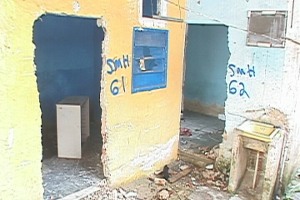
As in Vila Autodromo (see last month's series of post on this community's struggle), the SMH entered Favela do Metro and grafittied the facades of each house with their blue insignia. Residents were forced to sign papers confirming the expropriation of their houses by the government, and were told to make a split-second decision regarding their fates: accept, or decline, the government's compensation proposal.


Many accepted. Of approximately 900 original families, community leader Franci tells us, nearly half have already left Favela do Metro. Most have gone either to Minha Casa Minha Vida housing projects in Cosmos. Let me take this opportunity to remind you that it is common knowledge that the Cosmos projects are dominated by the militia, poorly-served by public transportation and more than 50km away from Favela do Metro. Other families have been relocated to the nearby Mangueira 1 residence, a social housing project provided via the state's Morar Carioca (Live Like a Rio-Dweller) iniative. We visited Mangueira 1 together with Franci after she led us on a walking tour of Metro. Mangueira 2 (identical to Mangueira 1), is being constructed nearby, and will house any remaining Metro residents who agree to sign the government's eviction papers. While Franci says Mangueira 1 is "highly preferable" to Minha Casa Minha Vida housing, she underscores that the best option would be for residents to remain right where they are. It should be noted here that unlike some other evictees, Favela do Metro residents are not compensated financially, and instead are offered housing in the Mangeuira or Minha Casa Minha Vida residences in exchange for their homes. Although the municipal government promised residents that they would subsidize rent in both Minha Casa Minha Vida and the Mangueira residences, Franci tells me that this money has yet to materialize. Instead, displaced residents are paying rent and utilities out of their own pockets.


And what of residents who do not view Minha Casa Minha Vida nor Mangueira 1 apartments as a fair trade for their current homes? What of residents who refused the government's quid pro quo? These residents - some 300 families - have remained in Favela do Metro, watching over there homes day in and day out with the hope that their on-site presence will preclude the destruction of their homes by the SMH. They have refused to bow to government, and will not accept relocation to Minha Casa Minha Vida as an option. As Mangueira 2 is only scheduled to be completed in November, the prospect of homelessness looms for these families; Franci informed us that the SMH has threatened to bulldoze the remaining homes as early as this weekend.


On our walk, we see a young woman standing alone in a field of rubble. Her gaze is set on the one home in our field of vision that remains standing; a two-story brick house nestled under an overpass. Newly-stray cats and dogs (Minha Casa Minha Vida housing prohibits pets) circle her feet, hoping for a handout.


We stop to talk to her. I ask her how long she has been here. I meant today, now, standing here alone. She interprets my question differently. "Since January", she says. She appears to acknowledge my quizzical eyebrow-raise, and adds, "I left my job in January to stay and watch over the house, so that they [the SMH] don't come and destroy it". She goes on to explain that although her family has accepted the government's resettlement offer and has moved to Mangueira 1, she still wants to keep a watchful eye on the home she left behind. I ask her where she will go when her house is demolished. "Talvez Mangueira," she says. "Maybe Mangueira (the comunidade). "Sei la," she adds. "I don't really know".


I press her for more details on the living conditions at Mangueira 1. Overall, she says, it is "okay". The biggest downfall is that regardless of size, families receive the same size unit, which consists of two rooms and a kitchen area. While the Mangueira units may be an upgrade in terms of size for some, many comunidade families had at least 6 members living in the same house (often with two or more stories). For these families, the move to Mangueira has resulted in severely cramped living quarters.


We continue our walk.


I had always assumed that evictions take place quickly, completely, and thoroughly. Bulldozers enter, knock down all of the "informal" structures, and leave. This has not been the case in Favela do Metro; much to the contrary, the SMH has adopted a strategy of what Metro residents call "minando" - literally "land-mining". "Minando" is the real-world manifestation of the children's game of Battleship, in which a player destroys his opponent's boats one at a time with the objective of eventually dismantling the entire fleet. In Battleship, there is no fun to be had in bombing all of your enemy's boats at once; the game would end quickly and there would be a fuss. Similarly, instead of taking out Favela do Metro in one fell swoop, the SMH has chosen to demolish only a handful of houses with each bulldozing. In some instances, homes have been left half-standing, with one side completely destroyed and the other perfectly intact. Why? Because - like Battleship - there is a certain appeal in backing your enemy into a corner and forcing him to surrender. Apart from making one's victory all the more gratifying, the "minando" strategy has the added benefit of having a "smoking out" effect on any residents who refuse to cede their homes.


How does this "smoking out" strategy manifest itself in Favela do Metro? It's not pretty, I can tell you that. What I saw this afternoon was nothing short of appalling. Mounds of rubble left behind by SMH bulldozers have created squalid conditions for the remaining residents. Cockroaches, rats, and mosquitoes can be seen swarming around the gaping holes in the ground where houses used to stand. The air reeks of human waste, the result of what Franci describes as "crackheads" using the half-demolished houses as drug dens. As the rubble pile-up has interfered with water drainage, ominous, algae-filled puddles have appeared on the sides of the becos - breeding grounds for dengue and leptospiorsis. The rubble-piles have also become the area's de-facto landfill, as other parties have taken to dumping their own trash on top of the heaps of wreckage.


There is also the issue of security. Franci brings us to the house of Eomar Freitas, one of the residents who has chosen to remain behind to watch over his home. I assume that, like the young woman we spoke to earlier in the visit, he means that he thinks his physical presence in the house will preclude an SMH bulldozing. He corrects me. He keeps watch over his home to dissuade potential thieves. "I've been robbed five times in five months," Eomar explains. "They took speakers, the air conditioner - even a glass window from the wall!" Eomar is not sure who is responsible for the theft of his property, but he is positive that the collapse of security within the community is due to the sporadic eviction process. "This place is a ghost town now, no one is left on the streets," he laments, adding that Metro never had a problem with breaking and entering prior to the SMH bulldozings. Eomar ends his diatribe by telling us that he sleeps in his empty house (his family has moved many belongings elsewhere, but what they left behind has been stolen), alone, every night.


Like Vila Autodromo's situation, Favela do Metro's eviction is laden with questionably legal justifications. But unlike Vila Autodromo, Favela do Metro residents do not hold title deeds, and they do not live on public land. This renders their legal case against removal different in nature, because by Brazilian law, informal residents occupying privately-held land cannot petition for concession of real right to housing (a legal instrument Brizola may have leveraged in order to grant titles to Autodromo residents). Instead, Metro residents wishing to file a lawsuit would have to try to win on the grounds of usucapiao - or adverse possession granted after 5-15 years of "illegal" occupation of private land. Usucapiao is notoriously difficult to demonstrate in court. Given that the municipal government mysteriously "re-assigned" public defenders assigned to communities threatened by removal, the chances of a successful class action lawsuit look slim.


After the visit was over, I walked back toward the metro station with another researcher. I thought about what Edesio had said in class, about the city's hypocritical exclusion of those who keep it running. I felt a pang of guilt, realizing that I had just visited a community which made possible the very transport system that had brought me to see it. A community of rail workers, maids, bus drivers, doormen. A community now being exiled from the very city it helped to create and continues to sustain.

Monday, July 4, 2011

History speaks volumes

I recognize that very often, I am guilty of failing to consider the impact of Brazilian history on the country's current social, economic, and political realities. Recalling the several hundred years' worth of events that transpired from Portuguese colonization to independence involves dusting off approximately the same number of cobwebs in my brain, so I was quite pleased to hear that our first class would be a crash course in the country's history.

As my research is on impact of extremely temporal events (The World Cup and the Olympics) on the Brazilian urban poor, I tend to focus my efforts on analyzing the current developments in law, politics, and social movements that are related to evictions. I need to constantly remind myself that while the municipal government's policy on comunidade removals is new, the rationale for it is not. In fact, the legal-political systems that are in place in today have much in common with the legal-political systems established by the 1824 Constitution - Brazil's first.

Therefore, we are looking at nearly 200 years of Brazilian property law favoring the individual over the collective, the rich over the poor, and the land-owner over the squatter. The result of such long-standing exclusionary policies is not pretty. 60% of the land is now is owned by a mere 3% of the population. 50%-80% of urban development is "informal" development. Land speculation and property value increases are among the highest in the world. "White eviction" in the city centers drives urban poor en masse to the distant, underserviced periphery. Although the federal government is investing an unprecedented amount of funds in urban development, sociospatial segregation continues unabated. The country's housing deficit stands at 7 million units, yet there are 5.5 million vacant or under-used properties. How on earth did this happen, and why has nothing changed?

Interestingly, concentrated land ownership and latifundio favoritism were not original tenets of the Portuguese colonizers. After signing the Treaty of Tordesillas, Portugal realized it may have overestimated its ability to populate the country at a speed that could outpace British, French, and Dutch invasions. The solution to foreign occupation of Portuguese territory was - in the eyes of Portugal - legalizing "land grabbing." Contrary to what Brazilian property law dictates today, in the 1500s, it was perfectly acceptable to occupy a tract of land without having documented legal ownership, as long as the land was being used for social or economic gain. In other words, in the early stages of Portuguese colonialism in Brazil, land ownership and land occupation were one and the same.

The initial acceptance of these early "squatters" and possession rights began to wane in 1850, with the passage of the 1850 Land Law, which legalized the registration of unoccupied tracts of land. This law undermined the previous property laws, which granted possession in exchange for productive occupation of the land. Now, citizens could buy up hectares of land at a time and claim legal rights, without the inconvenience of having to live on, till, or otherwise develop the land.

As Edesio summarized in class, "The 1850 Land Law effectively created the exclusionary, violent, and segregated state" we see in Brazil today. It has created a legacy of speculation, land concentration, and privatization of public space that continues to plague the country, while substantiating politics that favor a handful of landowning elites over the collective interest of the masses.

This favoritism has been irreversible and self-perpetuating for several reasons. One of the most visible reasons is, as I have discussed, is the clientelism within Brazilian political systems (see: Eike Batista and Sergio Cabral) A less obvious reason, as Edesio pointed out, is that most Brazilian lawyers receive an education that emphasizes the importance of conformity over creativity, and individual rights over collective rights. The result is generation after generation of lawyers who prefer to adhere to - not challenge - the status quo. Thus, newer, more progressive legal instruments are often tossed to the gutter, while antiquated laws remain in place.

This last point is critical. The problem is not that Brazil lacks the legal framework to enact good urban policy, it's that the policies it has enacted cater almsot exclusively the interests of the elite, and not those of the working class. A great number of laws - thousands, Edesio estimates - have been passed regarding land use, property rights, and possession, many of which are "excellent" and "ground-breaking", such as the 2001 City Statute , or the Zones of Special Social Interest. Many of these instruments, when envoked, can empower, benefit and legally "formalize" the "informal" poor. They can grant usucapiao (adverse possession), allow for land titling of informal settlements, and stipulate that abandoned buildings in city centers be used to re-settle evicted residents. However, the "informal" poor do not fund the electoral campaigns, do not loan out private jets at will, and otherwise do not serve the interests of Brazilian politicians. The antiquated legal system remains ingrained; a self-replicating cycle of conservatively-educated lawyers, clientelism, and narrow, self-serving interpretations of legislature.

And here we are today, in 2011, confronted with a very different set of problems than the Brazilians of centuries past. External threats have been replaced by internal threats, and instead of fearing invasions by the French and the British, the Brazilian government fears invasions by its own citizens. (Indeeed, the word invasor has become synonymous with favelado - a pejorative term used to refer to a person who lives in an "informal" settlement). However, the most basic problem - land - remains the same. Speculation, mega-events, and concentrated land ownership have combined to produce a perfect storm; one in which the government is able to expropriate land - or at the very least, control it - for its own gain. As the Brazilian government wages war on its own citizens for control of the comunidades either by occupations (see: UPPs) or by forcible eviction, the urban poor become more and more marginalized.

The most nefarious aspect of this war is its subtlety. Government programs which may seem innocuous at first glance - such as Minha Casa Minha Vida - reinforce the popular notion that the poor belong on the periphery by providing government-subsidized housing only in the farthest reaches of the city proper. The UPPs, extolled by the media and the municipal government alike, exercise a perverse form of cultural genocide on the comunidades they "serve" by banning baile funk parties, harassing anyone who looks "suspicious (read: young, black, male), and - in the most extreme cases - assassinating innocent citizens.

So, what is to be done? It seems as though a significant re-hauling of the political-legal system is in order. This new system must provide incentives for politicians to enact the plethora of laws that have already been establish to protect marginalized citizens, encourage legal professionals to adopt more flexible interpretations of pre-existing legislation, and - above all - demonstrate that what is good for the rich is, ultimately, also what is good for the rich.


Sunday, July 3, 2011

I'll be a fake lawyer for the next two weeks.

Tomorrow, I will begin auditing two courses on Brazilian urban management law at Fundacao Getulio Vargas (FGV). The courses are offered jointly through FGV and Tulane Law School, the umbrella institution for my masters program in International Development.

Both course will cover urban land policy vis-a-vis mega-event preparations in Rio de Janeiro, and will include lectures on Lefebrve's "right to the city", the 1988 Constitution, land titling, and the groundbreaking City Statute. I have the tremendous windfall of being taught by highly venerated property lawyer Edesio Fernandes, a man whose work I have admired for some time here in Brazil. So, hopefully I'll have some interesting perspectives to take away and share with you in the next few days.

Stay tuned.

Sunday, June 26, 2011

The Case of Vila Autodromo


Part 3 in a 6-part series on the forced removal of Vila Autodromo

Vila Autodromo, located in the expansive West Zone of the city, is one the comunidades whose permanency is being threatened by the SMH. On October 9th, 2009, Mayor Eduardo Paes called for the complete removal of the comunidade to make way for the Olympic Park, a BRL $37 million “leisure area” for Games
The Azure Letter. Houses marked for removal
in Autodromo. Photo credit: RioOnWatch
athletes that will also serve as the site of this year’s Rock in Rio music festival. Home to Seu Francisco and approximately 3,000 other residents, Vila Autodromo boasts more than 40 years of peaceful existence, free of the drug trafficking and violence that plague the vast majority of Rio’s other informal settlements.

I had the privilege of visiting Vila Autodromo last week to meet with community leader Jane Nascimento, who has been instrumental in the community’s fight against an otherwise sealed fate. Although the community was scheduled to be removed in March, the SMH has been unable to bulldoze a single house, thanks in part to Nascimento’s vociferous opposition. “They [the SMH ] have tried to come here a few times with their bulldozers,” she tells me. “But we have resisted. We blockade the roads, and they cannot enter.”
That same day, Jane leads me and a group of other independent researchers on a walking tour of Vila Autodromo. It is not difficult to see why the government is interested in this swatch of prime real estate, marking its territory with the now-infamous blue grafitti the SMH uses to deface the facades of houses it will soon remove. Peppered with lush vegetation, Autodromo is flanked by a main boulevard on one side and the lagoon on the other, and boasts top-notch views of the massive body of water. In order to legally remove the community, however, the government must navigate through a series of articles in the City Statue designed to protect land tenure for all but the most precarious settlements. One legal instrument is Article 429, the Lei Organica do Municipio, which stipulates that removal is only justified when an informal settlement occupies a tract of land that “poses a signficant risk to its residents.” This wording leaves some room for ambiguity in its definition of “significant risk”, and indeed it is this exact piece of legislation that is being manipulated by the municipal government in order to authorize the forced evictions. The SMH has recently cited “pollution” and “flood risk” as reasons for Vila Autodromo’s removal despite the fact that residents are hard-pressed to remember the last time the community had a flood, and that most of the water-borne pollution comes from other residential areas surrounding the lagoon, as Seu Francisco described.
Jane goes on to express her fear that, despite the community’s past success in thwarting demolition (the community was scheduled to be removed in March of this year), the SMH may soon begin bulldozing houses, businesses, and the newly erected community church. Particularly, she worries that residents will be relocated to the militia-controlled Minha Casa Minha Vida apartments, which offer little in the way of amenities – much less a community-built place of open worship. Jane explains, “If we are relocated, we want everything that we have here, there [in the Minha Casa Minha Vida complex].”

Wednesday, June 22, 2011

The Old Man and the Lagoon

Part 1 in a 6-part series on the forced removal of Vila Autodromo

Vila Autdromo on the margins of the Jacarepagua Lagoon.
Photo credit: favela.info
Grizzled, deeply tanned, and with cataracts that fail to obscure a pair of animated green eyes, Seu Francisco is the spitting image of Hemingway’s old fisherman. Like his fictitious Cuban counterpart, Seu Francisco’s life is characterized by his relationship to water. The Jacarepagua Lagoon, where Seu Francisco and 3,000 other residents have made their home, laps languidly at the shore below as he gazes out from his rooftop across the vast expanse of turbid blue. He recalls the days when fish were abundant in the lagoon, and provided him with a sufficient income for his family. He gestures to the opposite shore of the inlet on which his two-story house is perched, and directs my attention to an area of the lagoon where construction for the Olympic Games has begun. “See that? They pollute the water. They cut down trees. They dump their construction waste in the lake,” he explains. “I can’t fish here anymore. Now I must travel two hours to the next lagoon, where there are still fish.”
“What about the fish here?” I ask. “Where are they now?”
Seu Francisco shakes his head slowly. “Sumiram,” he says. “They disappeared.”
Thanks to an October 9th, 2009 decision by the municipal government to bulldoze his home to make way for Games-related construction, Seu Francisco may soon meet the same fate as his fish.